DIY Water Filter Lab – Engineering Design Challenge
Turn your classroom into a real-world water treatment lab where students think, design, test, and improve like environmental engineers.
In this hands-on engineering design challenge, students investigate a powerful real-world problem: How can we clean contaminated water after a natural disaster?
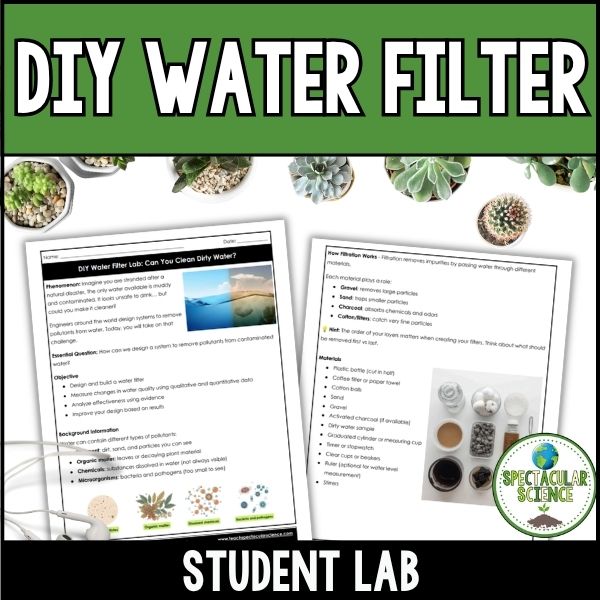
Students are tasked with designing and building their own multi-layer water filtration system using simple materials like sand, gravel, cotton, and activated charcoal. They then test their system using both qualitative and quantitative data, analyze results, and refine their design based on evidence.
This lab goes far beyond “build and observe.” Students collect measurable data, evaluate effectiveness, and connect their findings to how real water treatment plants work.
What Students Will Do
Students will:
- Design and build a multi-layer water filtration system
- Investigate contaminated “dirty water” using a real-world scenario
- Collect qualitative data (color, odor, visible particles)
- Collect quantitative data (turbidity scale, particle count, volume, time)
- Analyze changes in water quality using evidence
- Identify trade-offs in engineering design (speed vs effectiveness)
- Revise and improve their filter design
- Construct multiple CER (Claim-Evidence-Reasoning) explanations
- Connect their model to real-world water treatment systems
What’s Included
- Student lab handout (fully structured, print-ready)
- Pre-lab observation section
- Engineering design planning pages
- Calculations section (including percent reduction)
- CER writing framework
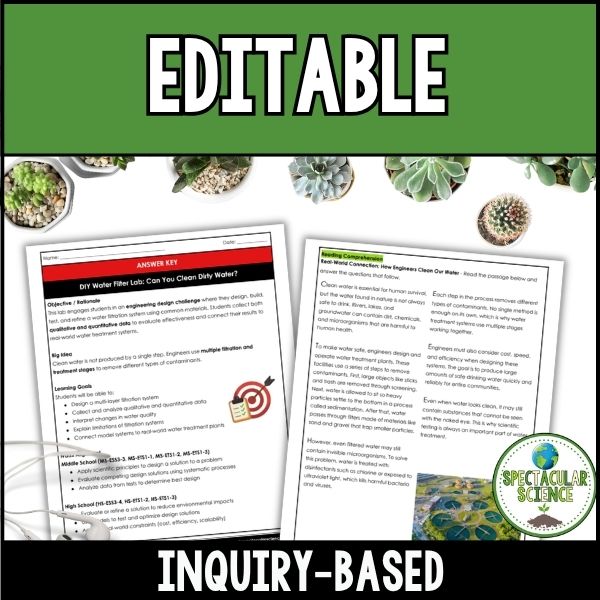
- Reading passage: “How Engineers Clean Our Water”
- Reading comprehension questions
- Answer key with sample responses
- Teacher notes and facilitation guidance
- Common misconceptions and how to address them
- Differentiation and extension ideas
NGSS Alignment
Perfect for middle school and high school engineering and Earth science standards, including:
- MS-ETS1-1, MS-ETS1-2, MS-ETS1-3, MS-ESS3-3
- HS-ETS1-2, HS-ETS1-3, HS-ESS3-4
Students engage in authentic engineering practices: defining problems, designing solutions, testing systems, analyzing data, and optimizing designs.
Why Teachers Love This Lab
- Highly engaging, hands-on engineering challenge
- Requires real data collection, not just observation
- Naturally supports CER writing
- Encourages revision and iteration (engineering mindset)
- Connects directly to real-world water treatment systems
- Easy prep using common classroom materials
- Strong cross-curricular literacy integration (reading + science)
Key Concept Connections
Students discover that:
- Clean-looking water is not always safe
- Different materials remove different types of contaminants
- No single filtration step is enough on its own
- Real water treatment requires multiple stages
- Engineering is about trade-offs, not perfect solutions
Classroom Ready
Whether you are teaching Earth Science, Environmental Science, Biology or an Engineering unit, this lab is designed to be plug-and-play while still supporting deep scientific thinking and data analysis.
Students leave with a clear understanding of how engineers solve global water quality problems and why filtration is only one part of the solution.
Grade Levels: 8th – 12th
Total Pages: 22
Teaching Duration: 90 Minutes
⭐ Looking for quality resources and time-saving tips for your secondary science classroom?
☑ Follow Spectacular Science on TPT
☑ Subscribe to My Newsletter
☑ Check Out My Blog
☑ Follow Me on Instagram
If you have any questions, please do not hesitate to ask.
Thanks for visiting!
Jessica