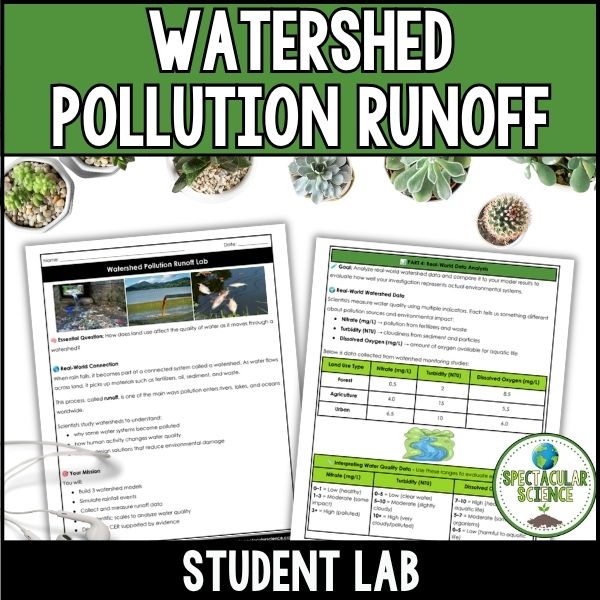
Bring environmental science to life with this highly engaging, NGSS-aligned Watershed Pollution Runoff Lab where students investigate how land use impacts water quality in real time.
In this hands-on investigation, students build and test three watershed models (forest, agricultural, and urban), simulate rainfall, and analyze how water carries pollution through a system. Using structured data collection, graphing, real-world datasets, and CER writing, students move beyond observation and into true environmental analysis.
What Makes This Lab Different
Instead of simply learning about pollution or watersheds, students:
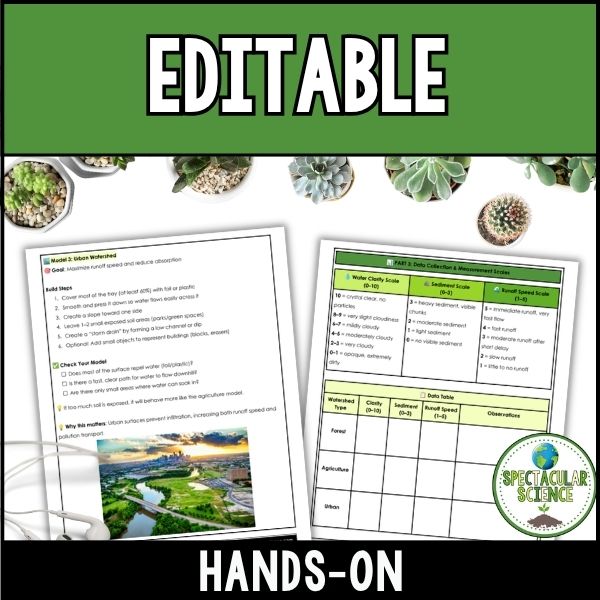
- Build and compare three realistic watershed models
- Simulate controlled rainfall events
- Collect quantitative and qualitative runoff data
- Use scientific scales for clarity, sediment, and runoff speed
- Analyze real-world water quality data (nitrate, turbidity, dissolved oxygen)
- Graph and interpret environmental trends
- Evaluate how well their model represents real systems
This is not a worksheet-style activity. It is a data-driven environmental investigation that mirrors how scientists study pollution and water systems.
What’s Included
Complete Student Lab + Teacher Guide
- Step-by-step watershed modeling investigation (forest, agriculture, urban)
- Checklist-style procedures and pre-lab predictions
- Data tables with built-in measurement scales (clarity, sediment, runoff speed)
- Analysis questions, graphing task, and real-world data comparison (nitrate, turbidity, dissolved oxygen)
- Higher-order thinking questions and CER writing section
- Engineering extension: design a cleaner watershed
Teacher materials include:
- Answer key with sample responses for all questions
- Sample data tables and graph expectations
- NGSS alignment (MS + HS) and learning goals
- Pacing guide, setup tips, and classroom management strategies
- Differentiation ideas, CER supports, and common misconceptions
Key Skills Students Build
Students will strengthen their ability to:
- Model how water moves through a watershed
- Analyze how land use affects pollution and runoff
- Interpret environmental data using scientific scales
- Graph and compare multiple data sets
- Connect classroom models to real-world environmental issues
- Construct evidence-based explanations using CER
Why Teachers Love It
- Highly engaging, hands-on investigation
- Clear structure with built-in scaffolds (great for independence)
- Strong focus on data collection, graphing, and analysis
- Includes real-world data for higher-level thinking
- Minimal prep with maximum student engagement
- Perfect for NGSS observations and evaluation lessons
- Encourages real scientific reasoning, not just completion
Perfect For
- Environmental Science Units
- Human Impact Lessons
- Water Pollution & Watersheds
- NGSS Performance Tasks
- Inquiry-Based Classrooms
- STEM Investigations
- End-of-Unit Labs or Assessments
Make Environmental Science Real
Students don’t just learn about pollution—they see how it moves, measure its impact, and connect it to real-world systems.
This lab helps students move from “water gets dirty” to understanding how and why human land use shapes entire ecosystems.
Grade Levels: 8th – 12th
Total Pages: 32
Teaching Duration: 3 Days
⭐ Looking for quality resources and time-saving tips for your secondary science classroom?
☑ Follow Spectacular Science on TPT
☑ Subscribe to My Newsletter
☑ Check Out My Blog
☑ Follow Me on Instagram
If you have any questions, please do not hesitate to ask.
Thanks for visiting!
Jessica