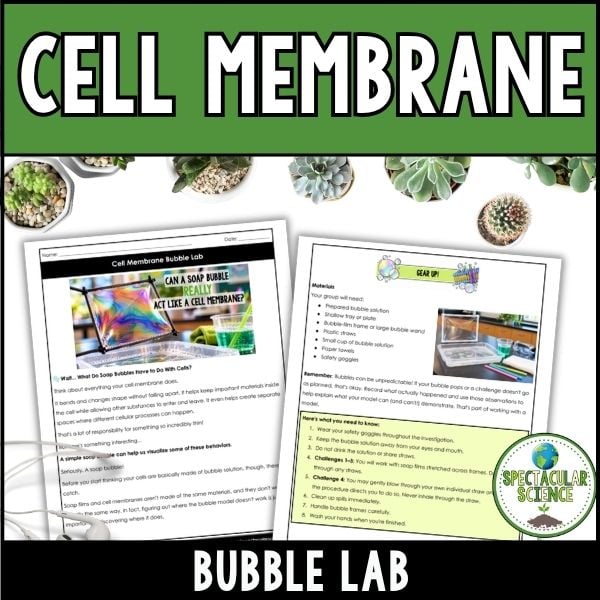
Can a soap bubble REALLY act like a cell membrane? Your students are about to find out!
In this hands-on Cell Membrane Bubble Lab, students use soap films, straws, and bubbles to investigate some of the characteristics of cell membranes, including flexibility, boundary maintenance, transport proteins, and compartmentalization.
But here’s where the real science happens: Students don’t just observe what the bubbles do. They investigate what these models can (and can’t!) tell us about actual cell membranes.
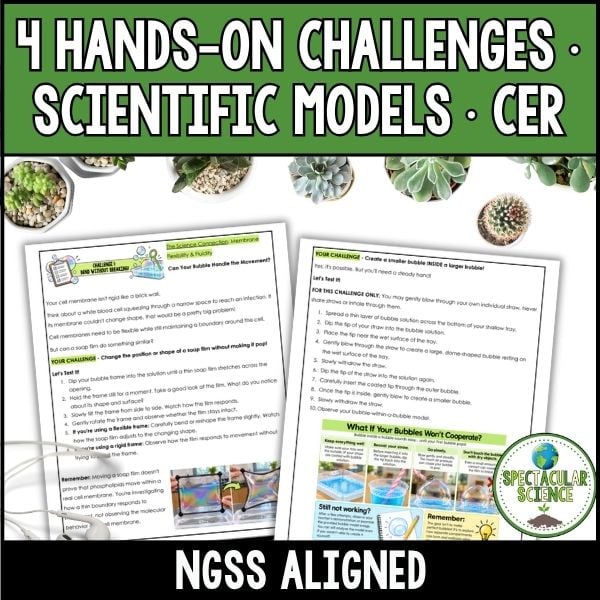
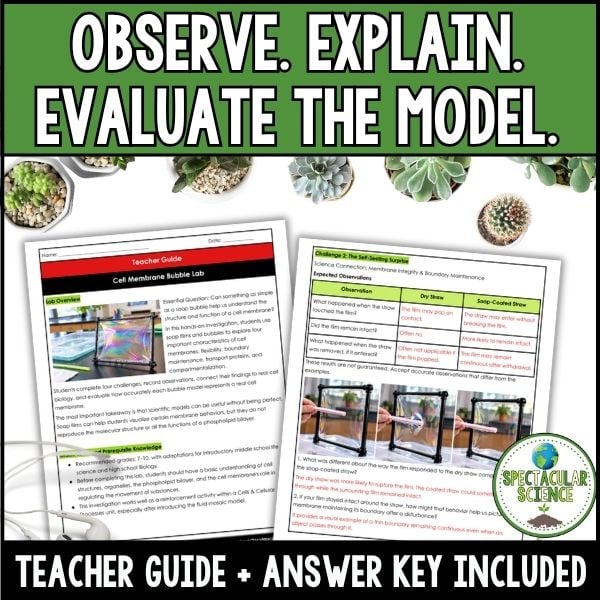
Through four interactive challenges, students make observations, connect their findings to cell biology, evaluate model limitations, and finish by constructing a scientific argument using evidence from their investigations.
The Four Bubble Challenges
🫧 Challenge 1: Bend Without Breaking!
Explore membrane flexibility by observing how a soap film responds to movement and changes in shape.
🫧 Challenge 2: The Self-Sealing Surprise
Investigate how a soap film can sometimes remain intact when a soap-coated straw passes through it, then connect the observation to membrane integrity.
🫧 Challenge 3: Access Granted… Or Denied?
Use a straw as a simplified model of a membrane channel and investigate why real cells need selective transport.
🫧 Challenge 4: A Bubble Inside a Bubble?!
Create nested bubbles to visualize compartmentalization and explore the importance of membrane-bound organelles.
What’s Included:
- Complete student investigation with four hands-on challenges
- Background reading, observation tables, and analysis questions
- Model comparison activity and final CER
- Teacher Guide, Answer Key, and optional extensions
Materials Needed: Bubble solution, shallow trays or plates, bubble-film frames or large bubble wands, plastic straws, small cups, paper towels, and safety goggles.
Recommended Grades: Middle School Life Science & High School Biology
Suggested Pacing: Two 45-minute class periods or one extended block period
This investigation works well during a Cells & Cellular Processes unit, especially after students have been introduced to the structure and function of cell membranes.
The goal isn’t to make perfect bubbles. It’s to get students thinking like scientists!
Students discover that a model doesn’t have to be perfect to be useful, but understanding its limitations is just as important as understanding what it demonstrates.
Grades: 7–10 | Pages: 35 | Time: 90 minutes
NGSS Connections: MS-LS1-2