Make groundwater visible, and unforgettable, for your students.
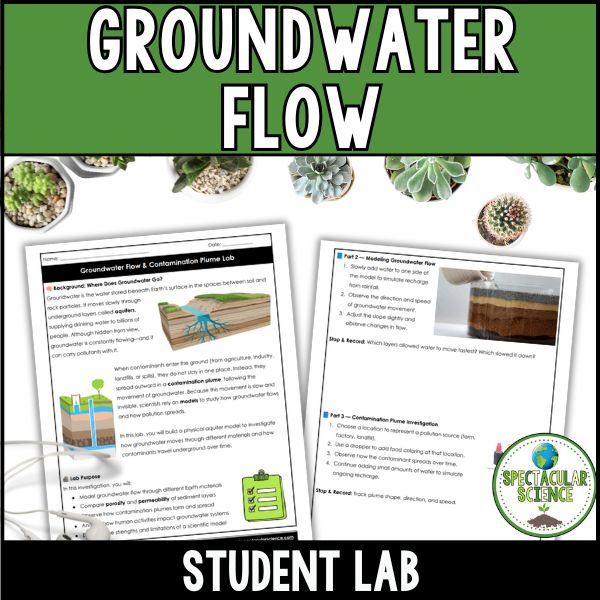
The Groundwater Flow & Contamination Plume Lab transforms an invisible Earth system into a hands-on, data-driven investigation where students build, label, and test a physical aquifer model. Using simple classroom materials, learners explore how groundwater moves through different sediment layers and how contaminants spread through underground systems over time.
Instead of memorizing vocabulary or static diagrams, students act as hydrogeologists—constructing layered aquifers, identifying the water table, comparing porosity and permeability, and tracking contamination plumes as they follow groundwater flow. Throughout the lab, students collect observations, analyze cause-and-effect relationships, and explain their findings using Claim–Evidence–Reasoning (CER).
Perfect for NGSS-aligned middle and high school Earth science, this lab emphasizes scientific modeling, energy transfer, and real-world environmental connections—while remaining easy to set up and highly engaging.
Why Teachers Love This Lab
- Hands-on and highly engaging—students can see groundwater flow
- Makes an invisible system concrete and understandable
- Strong focus on porosity vs. permeability using evidence
- Explicit modeling of contamination plumes and human impact
- Requires labeling and system thinking (aquifers, aquitards, water table)
- Built-in CER writing and higher-order analysis
- Clear structure that works for middle school through high school
- Uses low-cost, easy-to-find classroom materials
What’s Included
- Printable, student-friendly lab handout
- Engaging background reading introducing groundwater systems
- Front-loaded vocabulary section with student-owned definitions
- Step-by-step procedures with embedded student hints
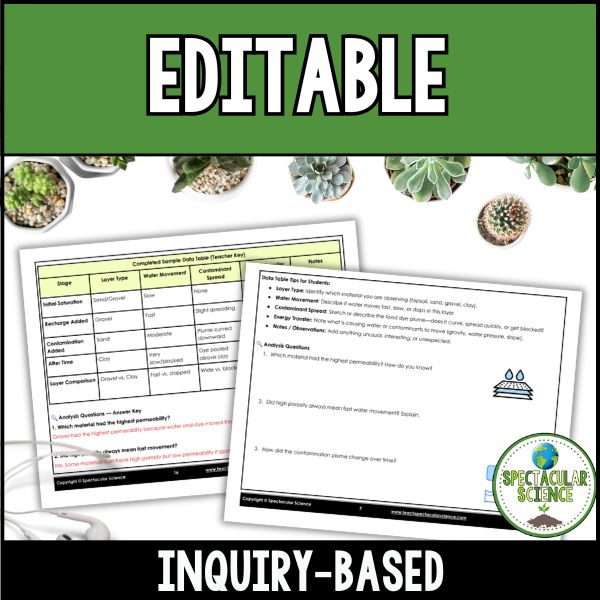
- Detailed data table aligned to NGSS practices
- Higher-order analysis questions focused on flow, contamination, and limitations
- Full CER writing task
- Real-world environmental connection prompts
- Formal concluding synthesis section
Full Teacher Guide Includes
- NGSS alignment (PEs, DCIs, SEPs, CCCs)
- Learning objectives and teacher rationale
- Estimated time frames and pacing guidance
- Teacher setup and classroom management tips
- Material notes and labeling guidance
- Completed sample data table
- Detailed answer keys
- Differentiation strategies for mixed-ability classrooms
- Common misconceptions with instructional fixes
- Extension ideas and assessment suggestions
What Students Will Learn
- How groundwater moves through permeable and impermeable layers
- The difference between porosity and permeability
- How contamination plumes form and spread underground
- How energy (gravity and pressure) drives groundwater flow
- Why groundwater contamination is difficult to detect and clean
- How to evaluate the strengths and limitations of scientific models
- How to support scientific explanations using Claim–Evidence–Reasoning
Easy Setup, High Engagement, Meaningful Science
With clear procedures and familiar materials, students quickly move from curiosity to deep scientific thinking. This lab replaces abstract diagrams with active modeling, observation, and explanation—making it a powerful anchor activity for any groundwater, water resources, or human impact unit.
Engaging, standards-based, and classroom-tested—this is the groundwater lab students actually understand and remember.
Grade Levels: 8th – 12th
Total Pages: 19
Teaching Duration: 90 Minutes
⭐ Looking for quality resources and time-saving tips for your secondary science classroom?
☑ Follow Spectacular Science on TPT
☑ Subscribe to My Newsletter
☑ Check Out My Blog
☑ Follow Me on Instagram
If you have any questions, please do not hesitate to ask.
Thanks for visiting!
Jessica