Grow, design, test, and engineer crystals—just like real materials scientists!
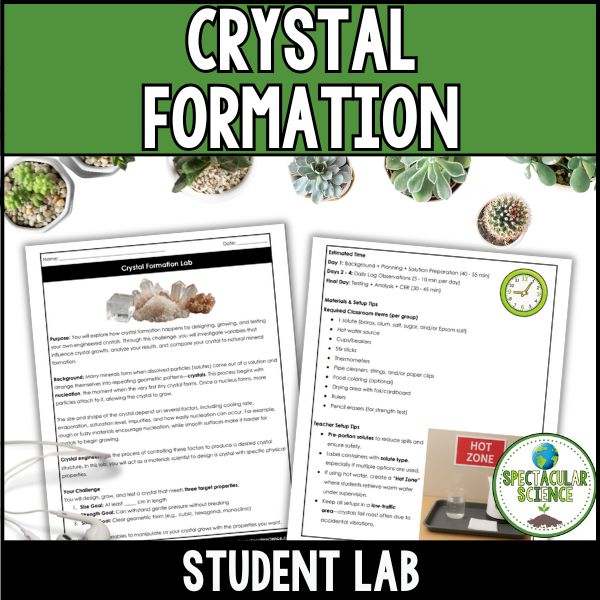
This hands-on Crystal Engineering Challenge transforms abstract mineral science into an exciting, creative, and data-driven investigation. Students explore how crystals form, how variables influence structure, and how engineered materials can be designed with specific properties in mind. Using simple materials, learners grow their own crystals, test them for size, strength, and shape, and analyze how their engineering choices affected the final product.
Perfect for NGSS-aligned middle and high school Earth science and chemistry, this lab helps students move beyond “pretty crystals” and toward real scientific thinking. Learners design a plan, manipulate variables, observe nucleation and crystal growth over time, carry out strength and size tests, and explain their results using CER writing and evidence-based reasoning.
Why Teachers Love This Lab
- Hands-on, creative, and highly engaging
- Easy setup with flexible solute options (borax, sugar, alum, epsom salt, etc.)
- Connects crystal formation to real-world mineral science
- Students control variables—true engineering design experience
- Includes planning charts, guided observation logs, and CER prompts
- Clear, structured differentiation and built-in scaffolds
- Encourages deep understanding of saturation, nucleation, evaporation, cooling rate, and crystal structure
What’s Included
- Printable, student-friendly lab handout
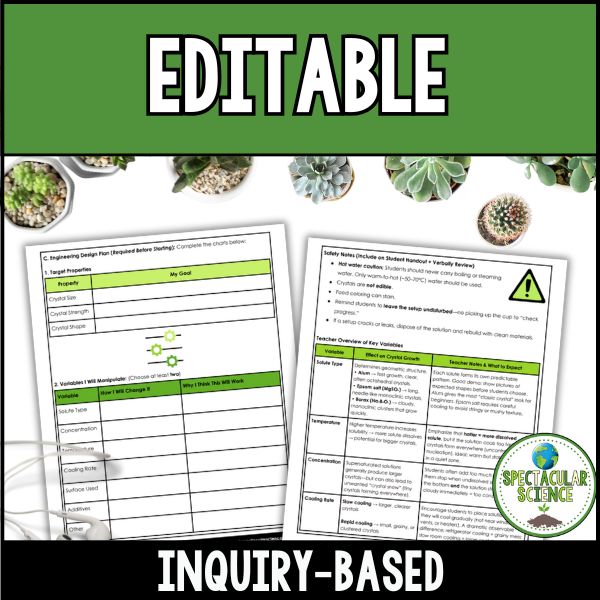
- Engineering design plan (targets, variables, predictions)
- Step-by-step procedures with built-in student tips
- Daily observation log with structured prompts
- Crystal testing section (size, strength, shape analysis)
- Engineering results data table
- Higher-order analysis and reflection questions
- Full CER writing prompt
- Visuals, diagrams, and vocabulary references (saturation, nucleation, cooling rate, etc.)
Full Teacher Guide Includes
- Standards alignment (NGSS, PEs, DCIs, SEPs, CCCs)
- Setup tips and safety guidelines
- Example completed planning charts, observation logs, and results tables
- Example crystal shape identifications
- Model CER response
- Differentiation strategies for mixed-ability classrooms
- Troubleshooting guide (e.g., no crystal growth, clumping, foggy solution)
- Complete answer key for all student questions
What Students Will Learn
- How solubility, saturation, temperature, and evaporation affect crystal formation
- How nucleation creates the starting point for crystal growth
- How variables can be engineered to produce specific structures and properties
- How natural mineral crystals form under different geologic conditions
- How to justify scientific conclusions using Claim–Evidence–Reasoning
- How engineered materials differ from naturally formed ones
Easy Setup, High Engagement, Meaningful Science
With only water, solute, and a growth surface, students create their own mineral models and build a strong conceptual foundation for Earth science, chemistry, and engineering. This lab inspires curiosity and produces beautiful, unique results—while still being fully standards-based and academically rigorous.
Grade Levels: 8th – 12th
Total Pages: 22
Teaching Duration: 5 Days
⭐ Looking for quality resources and time-saving tips for your secondary science classroom?
☑ Follow Spectacular Science on TPT
☑ Subscribe to My Newsletter
☑ Check Out My Blog
☑ Follow Me on Instagram
If you have any questions, please do not hesitate to ask.
Thanks for visiting!
Jessica