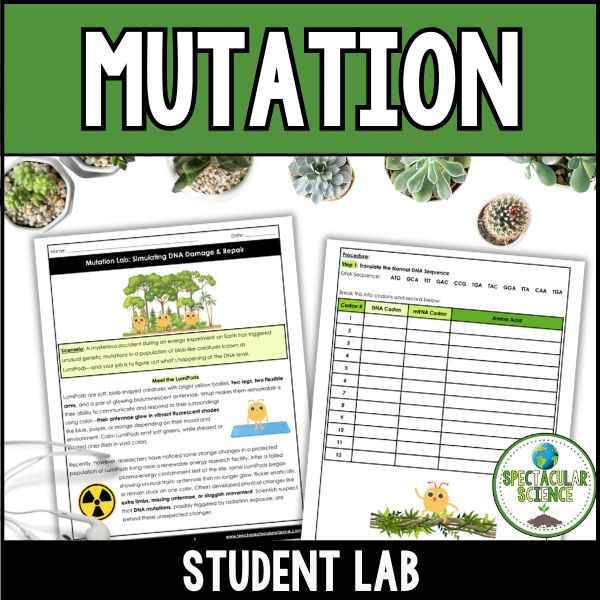
Through DNA transcription and translation, codon analysis, and a mutation simulation activity, students see firsthand how insertions, deletions, and substitutions affect the amino acid sequence of a protein—and ultimately change an organism’s appearance or behavior. They apply their findings in a creative final task: drawing their mutated LumiPod based on protein-level changes, then constructing a Claim-Evidence-Reasoning (CER) to support their conclusions.
Why Teachers Love This Activity:
- Real-World DNA → Trait Connections – Rather than memorizing definitions, students actively simulate mutations and follow the chain reaction from DNA to mRNA to protein to phenotype—making abstract molecular biology concrete and visual.
- Built-In Higher-Order Thinking – From mutation analysis to CER writing and trait prediction, students think critically about how structure affects function and how even a single DNA change can make a big difference.
- Standards-Aligned & Classroom Ready – Supports NGSS HS-LS1-1 (DNA and protein structure), HS-LS3-1 (DNA codes for traits), and HS-LS3-2 (mutations as sources of variation)—with no extra prep required.
- Creative and Engaging – The LumiPod storyline gives a fun, sci-fi twist that hooks students and invites them to apply content knowledge in a way that feels imaginative, not textbook-driven.
- Flexible Pacing – The lab is rich in content and thinking. Some teachers find it best to split over two class periods for deeper comprehension, discussion, and creativity.
How It Works:
- Meet the LumiPods – Students are introduced to a fictional Earth species whose antennae glow based on protein function and mood—and who are now mutating after a mysterious radiation leak.
- Simulate the Mutation – Each group draws a unique mutation card (substitution, insertion, or deletion), modifies the DNA sequence, and analyzes how the change affects the amino acid chain.
- Follow the Effects – Students determine whether a frameshift occurred, what kind of protein was produced, and how the LumiPod’s trait would be affected.
- Draw the Mutant – Based on the mutation’s outcome, students illustrate what the new LumiPod might look like, reinforcing the idea that DNA mutations can result in observable phenotypic changes.
- Make the Case – Students wrap up by writing a CER that argues whether all mutations lead to major trait changes—using their own data as evidence.
What’s Included:
- Student Lab Packet – Includes scenario background, DNA/protein analysis tables, embedded check-in questions, drawing prompts, and CER response task.
- Mutation Cards – Ready-to-use or printable prompts for insertions, deletions, and substitutions that alter different regions of the DNA.
- Teacher Guide & Full Answer Key – Includes DNA solutions, protein translations, predicted trait effects, CER model responses, and teaching tips.
- Flexible Format – Use as a partner lab, individual investigation, or small group station activity.
Why Students Will Love It:
- “Wait… my LumiPod grew a second antenna?” – The built-in story and visual drawing task make learning personal and imaginative—while reinforcing complex molecular biology in a way that sticks.
- “My mutation didn’t even change the protein… huh.” – Students discover that not all mutations are created equal—and experience the difference between silent, point, and frameshift mutations for themselves.
Pro Tip: Stretch this activity across two class periods to maximize engagement and critical thinking. Use the mid-lab questions and CER writing as anchor points for group discussion, formative check-ins, or even a mini gallery walk of mutant LumiPod drawings.
Grades: 8–12 | Pages: 15 | Time: 60 minutes
NGSS Connections: HS-LS1-1, HS-LS3-1, HS-LS3-2