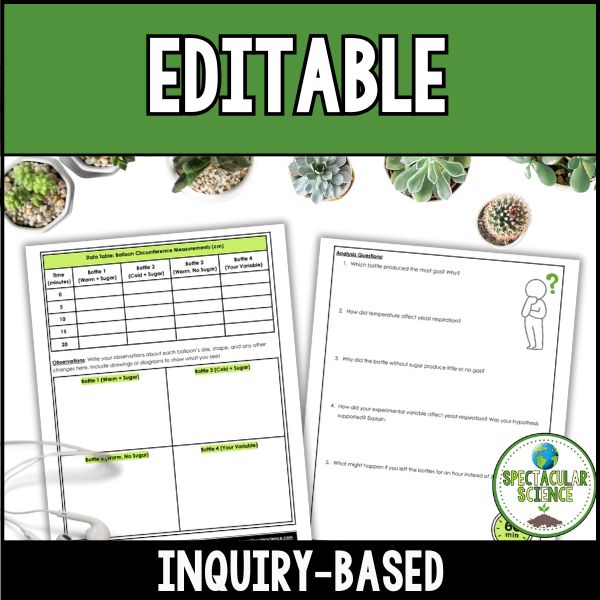
The Yeast Respiration Lab invites students to explore how living organisms can generate energy without oxygen in a hands-on, inquiry-based experiment. Students investigate how temperature and sugar availability affect anaerobic respiration in yeast by measuring carbon dioxide production through balloon inflation.
Through guided experimentation, real-time data collection, and open-ended investigation, students uncover the conditions yeast need to “breathe” anaerobically — and then take on the challenge of designing their own test using a variable of their choice.
Why Teachers Love This Activity:
- Real Biology, Real Gas Production – Students observe fermentation firsthand, reinforcing key concepts of anaerobic respiration and metabolic processes.
- Built-In Inquiry & Critical Thinking – The second half of the lab challenges students to think like scientists by designing their own experiment, manipulating variables, and forming hypotheses.
- Curriculum-Aligned & Versatile – Supports NGSS performance expectations related to cellular respiration, chemical reactions, and energy transfer in life science.
- Accessible for All Learners – Visual observations, scaffolded questions, and a clear, structured format ensure meaningful participation for students at all levels.
- Low-Cost, High-Impact – Uses easy-to-find materials like sugar, yeast, water bottles, and balloons — perfect for classrooms with limited budgets or supplies.
How It Works:
- Set Up the Experiment – Students prepare three test bottles with different conditions (warm vs. cold water, sugar vs. no sugar), each containing yeast and sealed with a balloon.
- Watch the Balloons Rise – As the yeast ferments sugar, carbon dioxide is produced and trapped by the balloon. Students measure the circumference of each balloon at regular intervals.
- Collect & Compare Data – Over 20 minutes, students measure balloon growth, record their data, and note visual changes.
- Design Their Own Test – In Part 2, students pick an additional variable (e.g., salt, honey, lemon juice, light exposure) to test its effect on yeast respiration.
- Analyze & Reflect – Through targeted analysis questions, students interpret their results, evaluate their hypotheses, and consider the real-world significance of anaerobic respiration.
What’s Included:
- Student Lab Packet with data tables, observation space, and built-in analysis questions
- Answer Key & Teacher Tips with setup guidance, troubleshooting help, and sample responses
- Materials List and safety guidelines for smooth classroom execution
- Extension Opportunities for deeper inquiry or longer lab periods
Why Students Will Love It:
- Balloons + Chemistry = Fun – There’s something magical about watching a balloon inflate from invisible gas produced by tiny organisms!
- Hands-On Discovery – Students take ownership of their learning through active experimentation and creative variable testing.
- Real-Life Connection – From bread rising to fermentation in foods and fuels, students discover how respiration affects the world around them.
Materials (per group):
- 4 plastic bottles (16 oz)
- 4 balloons (standard size)
- Active dry yeast (1 tbsp per bottle)
- Granulated sugar (1 tbsp per bottle for sugar trials)
- Warm water (~40°C/104°F) and cold water (~10°C/50°F)
- Measuring spoons & funnel
- Thermometer, tape measure/string & ruler
- Stopwatch or timer
- Optional: Additional variables (e.g., salt, honey, vinegar, artificial sweetener)
Pro Tip: Pre-measure yeast and sugar in small cups to streamline setup. Use a class demo of the warm sugar setup inflating a balloon to grab student attention right away. Then ask: “What’s making the balloon grow?” to kick off student inquiry into the power of yeast!
Grade Levels: 8th – 12th
Total Pages: 14
Teaching Duration: 60 Minutes
⭐ Looking for quality resources and time-saving tips for your secondary science classroom?
☑ Follow Spectacular Science on TPT
☑ Subscribe to My Newsletter
☑ Check Out My Blog
☑ Follow Me on Instagram
If you have any questions, please do not hesitate to ask.
Thanks for visiting!
Jessica