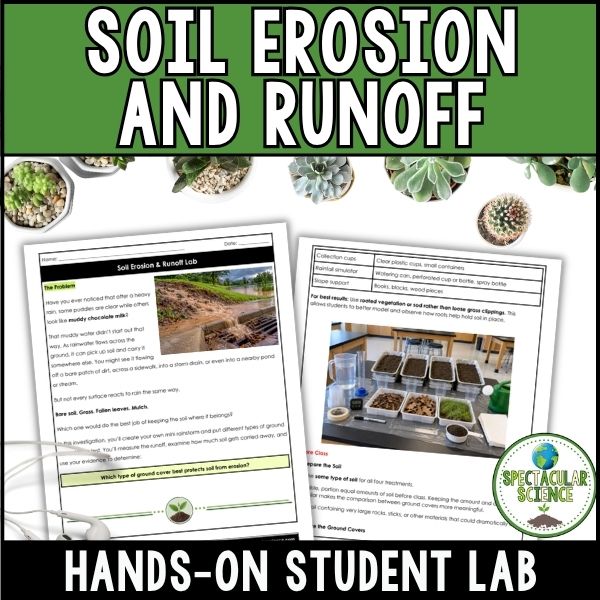
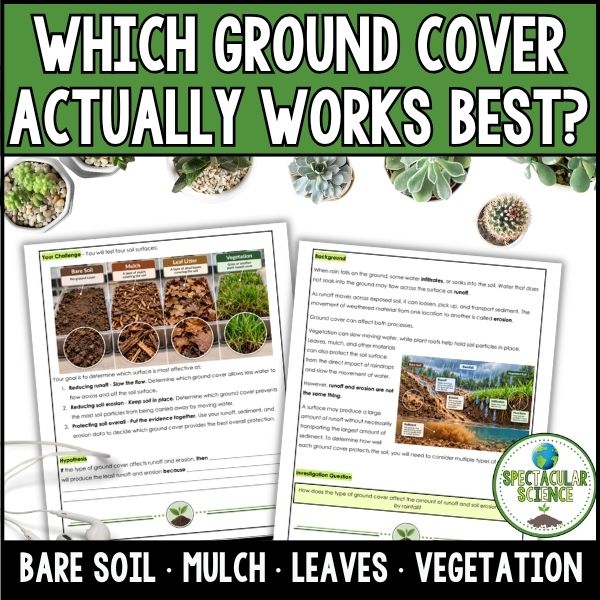
One rainstorm. Four different ground covers. Which one actually does the best job of keeping soil where it belongs?
Turn soil erosion and runoff into something your students can actually see, measure, and investigate with this hands-on Soil Erosion & Runoff Lab!
Students create their own mini rainstorm and put bare soil, mulch, leaf litter, and vegetation to the test. They collect the runoff from each surface, measure how much water leaves the tray, examine turbidity and sediment, and look for visible evidence of erosion.
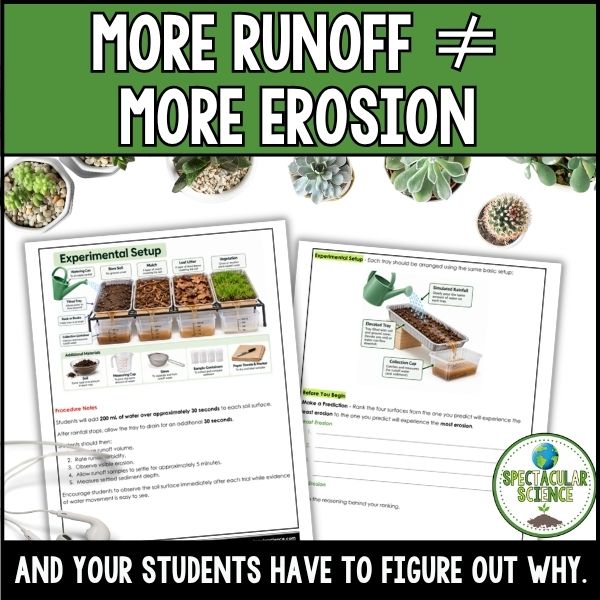
But there’s more to the story than which tray produces the most runoff.
More runoff does not automatically mean more erosion.
Students have to put multiple pieces of evidence together to determine which ground cover actually provides the best protection. They’ll calculate percent runoff, graph their results, compare sediment and turbidity, and use their data to defend an evidence-based conclusion.
Then they take what they discovered beyond the lab and apply it to a familiar real-world problem: that muddy “chocolate milk” water flowing across sidewalks and into storm drains after a heavy rain. What could be done to keep more soil in place?
Along the way, students consider limitations of their model and predict what might happen if they changed the slope, amount of rainfall, rainfall intensity, or type of soil.
What’s Included:
- Complete 45–60 minute student investigation
- Four ground-cover treatments: bare soil, mulch, leaf litter + vegetation
- Runoff, turbidity, sediment + erosion data collection
- Percent runoff calculations + graphing
- Analysis + model limitations
- Evidence-based conclusion
- Real-world application + extension
- Complete sample answer key
- Comprehensive teacher guide
- Setup, troubleshooting, differentiation + NGSS alignment
Why Teachers Love This Activity
- Students aren’t just watching erosion happen. They’re collecting multiple types of evidence to figure out which surface actually protects soil best.
- The four ground covers make it easy for students to see differences in runoff and erosion while connecting the investigation to surfaces they encounter in real life.
- Students discover an important idea that can easily get missed: runoff and erosion are not the same thing.
- The investigation naturally incorporates measurement, calculations, graphing, data analysis, modeling, and evidence-based reasoning.
- Two setup options let you run the full investigation with every group or divide the treatments across the class when materials are limited.
- A comprehensive teacher guide walks you through prep, setup, materials substitutions, troubleshooting, differentiation, sample results + more.
- It gives students a hands-on experience while still asking them to think about what their data actually mean.
Materials Needed: Shallow trays or containers, soil, collection cups, water, measuring cup or graduated cylinder, mulch, dead leaves, rooted vegetation or sod, ruler, materials for creating a slope, and a simple method for creating simulated rainfall.
Perfect for: Earth Science, Environmental Science, Weathering & Erosion, Soil Science, Earth’s Surface Processes, Runoff & Watersheds, Scientific Models, Experimental Design, and Human Impact on the Environment.
Grade Levels: 6th – 10th
Total Pages: 40
Teaching Duration: 45–60 minutes
⭐ Looking for quality resources and time-saving tips for your secondary science classroom?
☑ Follow Spectacular Science on TPT
☑ Subscribe to My Newsletter
☑ Check Out My Blog
☑ Follow Me on Instagram
If you have any questions, please do not hesitate to ask.
Thanks for visiting!
Jessica