




Do you like puzzles? If so, I’ve got a teacher tool that’s like a puzzle in that you fit pieces together, and upon completion, you can marvel at your work with a great sense of accomplishment. Spoiler alert: It’s a pacing guide for your science class!
Using a pacing guide in your science class is like building a puzzle. The pacing guide is similar to the puzzle box image showing you the intended finished product. It clearly outlines how the different pieces of your curriculum can fit together. And if we keep going with this metaphor, in creating the guide you assemble a whole bunch of pieces, including those beloved corner pieces (aka the cornerstones of your curriculum).
Keep reading to learn about the benefits of pacing guides and steps to success for creating your own!
Understanding the Purpose of a Pacing Guide
A pacing guide is a detailed schedule or outline of timelines for specific units, lessons, and concepts throughout a course.
This timeline will ensure comprehensive coverage of the curriculum you have to deliver. It provides a welcome structure for teachers and students.
As a teacher, imagine knowing what you’ll be teaching from day to day or not having to worry part-way through the year that you can (or can’t) cover everything you need to before the end of the year!
Stress relief is probably the biggest benefit of a pacing guide!
There are other benefits too!
You can maintain instructional consistency since there’s a clear plan. As the teacher you will know from day to day and month to month what you’ll be covering in class. This allows you to really scaffold lessons and skills within your curriculum because you can see the vision of the whole year.
You can facilitate differentiation and personalized instruction because you can tweak the guide when and how you need to depending on the students in your classes. A pacing guide is a guide; meaning it can be adjusted as needed.
Let’s go back to that puzzle metaphor here for a moment. There is always a time when you’re assembling a puzzle that frustration looms large. In that moment you can do one of three things:
- Give up. (We know as teachers that this really isn’t an option so skip ahead to choices 2 and 3!)
- Step away to adjust your mindset. For teaching this means reflecting on how to re-deliver a lesson or to approach the guide/unit/lesson with fresh eyes. (Check out this post about how to know when you need to re-teach something.)
- Shift to another section of the puzzle. For teaching this means moving away from the initial plan whether that’s potentially going back or skipping ahead in the curriculum.
Let’s go back to that puzzle metaphor here for a moment. There is always a time when you’re assembling a puzzle that frustration looms large—usually when you’re convinced a piece is missing… only to realize it’s been under the table the whole time.
Teaching feels like that sometimes too.
This is all to say that a pacing guide is a strategy and a tool that teachers can use to their best advantage but they don’t need to be beholden to the document at all times. Adjust when and as needed!
Tailoring Your Pacing Guide: 6 Steps for Success
- Conduct a thorough analysis of curriculum standards and requirements
- Identify essential learning objectives and prioritize content
- Integrate formative and summative assessments to gauge student progress
- Allocate time for review, remediation, and enrichment activities
- Utilize available resources effectively, including textbooks, technology, and supplemental materials
- Incorporate flexibility into the pacing guide to accommodate unexpected events or student needs
Reflections: Assessing Timing, Resources, and Needs
A key aspect of a pacing guide is that it is meant to be a ‘living’ document that can be flexible and adaptable.
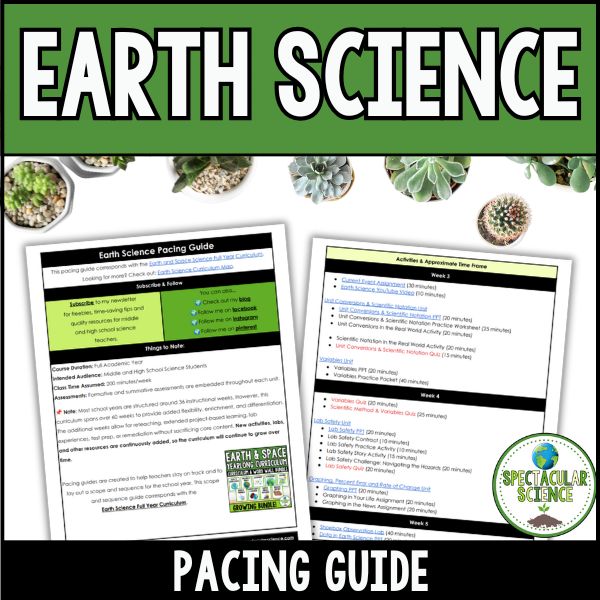
For example, this Earth Science Pacing Guide for the full year is a strategic tool to optimize teaching plans and promote efficient planning and curriculum coverage. Teachers can adapt this tool to suit their needs and most importantly the needs of their students.
After completing your first-ever pacing guide or in anticipation of creating one after having already taught a course without one, reflection is necessary.
Take time to review the year of teaching and think about:
- Successes – What worked well in terms of timing and/or specific lessons or units?
- Areas for improvement – What could have been better? What lessons need revision because they fell flat or just weren’t as successful as expected?
- Gaps in curriculum coverage and areas where adjustments are needed – What was missing? Where did students struggle and why might they have struggled?
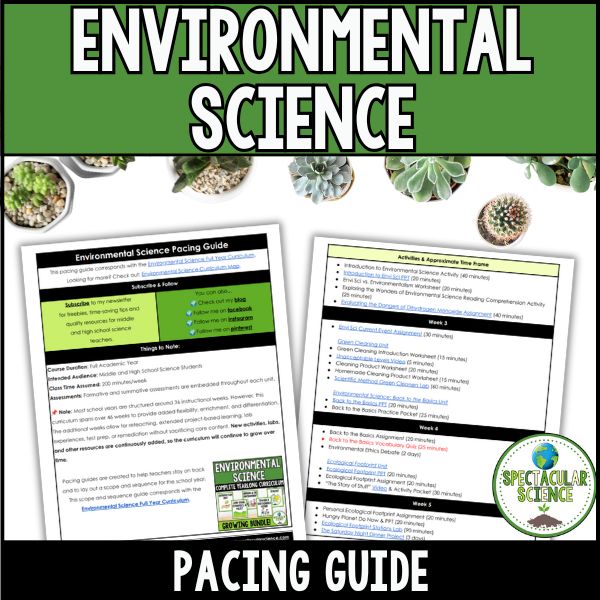
For Environmental Science, check out this pacing guide that’s been meticulously designed to help teachers maintain focus and structure throughout the academic year. With this guide, you’re able to skip the time-consuming work of creating your pacing guide and just jump to the reflection component in a year’s time! This is yet another way to save your time and reduce your stress!
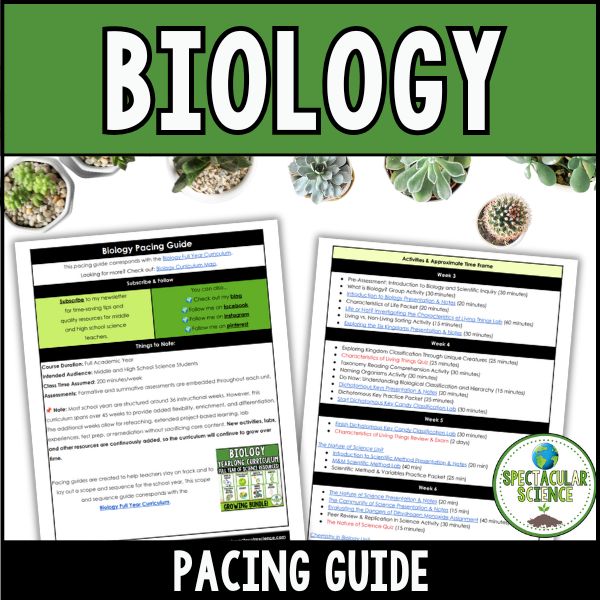
My Biology pacing guide is here to make a busy year feel a little more manageable. With so many concepts building on each other, it helps you plan lessons and labs without constantly recalculating timing. You can focus on what matters—student understanding and hands-on learning—while still leaving room to reflect, adjust, and make the course fit your students’ needs.
Want a Head Start? Grab a Free Pacing Guide 👀
If you’re reading this and thinking, “This all sounds great, but I do NOT have time to start from scratch,” I’ve got you covered.
I’ve created free, classroom-tested pacing guides for each of my science curricula—designed to give you that big-picture clarity without the hours of trial and error.
These aren’t rigid scripts. They’re flexible, teacher-friendly roadmaps you can actually use. My pacing guides were built to be starting points—not final drafts. They give you a full-year vision while leaving room for snow days, reteaching moments, surprise assemblies, and those classes that need a little extra time.
👉 Grab the free pacing guide that fits your course:
- Biology Pacing Guide – A year-long overview that helps you balance content, labs, and skills without rushing the big ideas.
- Environmental Science Pacing Guide – Built around real-world connections, sustainability themes, and natural flow between units.
- Earth & Space Science Pacing Guide – A full-year framework that keeps concepts cohesive instead of feeling scattered.
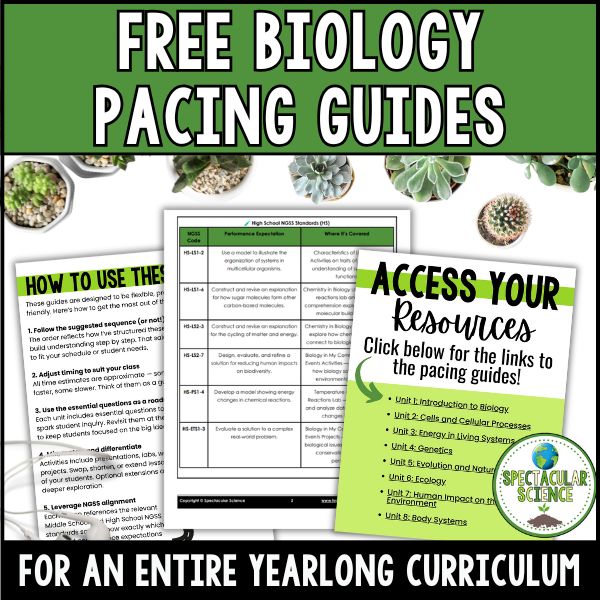
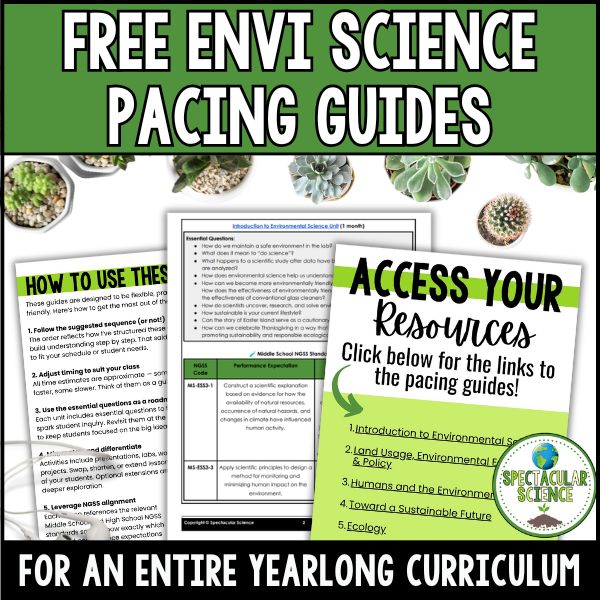
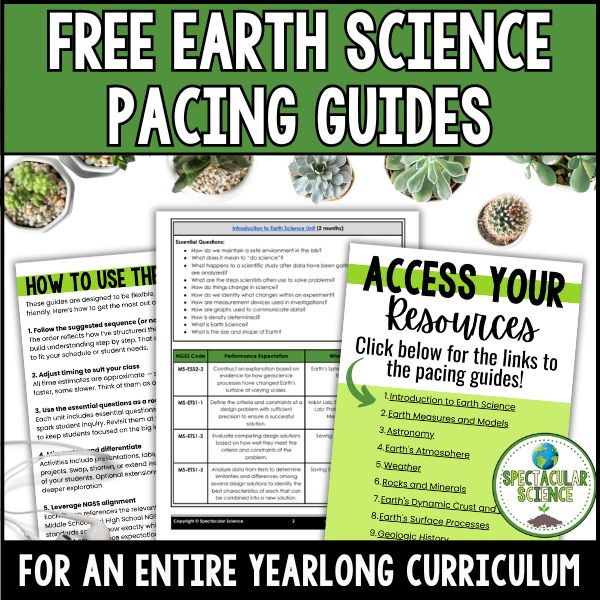
Each pacing guide comes as a teacher-friendly welcome packet—not just a single document you download and forget.
Inside, you’ll find:
✔ A full-year pacing overview so you can see how the entire course fits together
✔ Suggested timelines for each unit (with built-in flexibility)
✔ Planning notes to help you adjust pacing based on your students and schedule
✔ A clean, organized starting point you can customize without starting from scratch
The goal? Less guesswork, less stress, and more time focused on teaching.
Final Thoughts: You Don’t Have to Reinvent the Wheel
If there’s one thing I’ve learned from years in the science classroom, it’s this:
Good planning reduces stress—but flexible planning keeps you sane.
A pacing guide won’t solve every challenge, but it will give you clarity, confidence, and a plan you can adjust instead of abandon.
If you want to start with a framework that’s already been thought through, tested, and teacher-approved, grab one of my free science pacing guides and make it your own.
Your future self (and your Sunday evenings) will thank you.
RELATED POSTS:
- HOW TO MAP OUT YOUR EARTH AND SPACE SCIENCE CURRICULUM
- CREATING CHANGE THROUGH THE FUNDAMENTALS OF ENVIRONMENTAL SCIENCE
- TIPS TO KNOW WHEN AND HOW TO RE-TEACH SCIENCE LESSONS