The lights go off. The movie starts. Someone immediately asks if they need to take notes.
If you’ve ever shown a movie in class, you probably know the moment.
Movie days can get a bad reputation, but I don’t think pressing play automatically means pressing pause on learning. A movie can give students a shared experience to question, investigate, and connect to what they’re studying.
When I was teaching, I showed A Smile as Big as the Moon and The Lorax every year. They offered very different experiences, but both gave us something worth talking about.
My students LOVED A Smile as Big as the Moon. It incorporated space while opening up conversations about empathy and students with disabilities. The Lorax gave us a familiar story through which to explore sustainability and environmental responsibility.
That’s what I look for in a classroom movie: something students can keep thinking about after the credits roll.
Below are 10 movies to consider when planning meaningful discussions in middle or high school science. I’ve included science connections, questions, and follow-up ideas to help you take each one beyond watching.
A quick planning note: I haven’t personally watched every film on this list. Preview any movie or selected scene before using it, consider your students and your school’s guidelines, and check the exact version you plan to show. Several titles explore mature topics and may be more useful for your own viewing or carefully selected excerpts.
Which Movie Fits Your Science Lesson?
| Movie | Science connections | Possible lesson use |
|---|---|---|
| A Smile as Big as the Moon | Space exploration, teamwork, inclusion | Discuss access to STEM opportunities |
| The Lorax | Sustainability, natural resources, ecosystems | Redesign a business to reduce its environmental impact |
| WALL-E | Waste, consumption, environmental stewardship | Investigate the hidden impacts of everyday products |
| Apollo 13 | Engineering, constraints, problem-solving | Evaluate solutions using limited materials |
| October Sky | Rocketry, testing, persistence | Analyze how evidence informs a redesign |
| Hidden Figures | Space exploration, mathematics, representation | Research the people behind a scientific achievement |
| The Martian | Survival, biology, planetary conditions | Investigate a scientific claim from a scene |
| Dark Waters | Chemical pollution, environmental health | Evaluate evidence about an environmental concern |
| Erin Brockovich | Water quality, environmental justice | Research drinking water and water treatment |
| Jurassic Park | Genetics, biotechnology, scientific ethics | Separate scientific possibilities from fictional leaps |
1. A Smile as Big as the Moon
Space exploration, teamwork, and inclusion
This one has a permanent place on my list.
A Smile as Big as the Moon follows a teacher and his students with disabilities as they work toward attending Space Camp. The space connection drew it into my classroom, but the opportunities to discuss empathy and inclusion made it especially meaningful.
I showed it every year, and my students loved it.
Science education involves more than understanding concepts. It also involves thinking about who gets opportunities, whose abilities we recognize, and what meaningful support looks like.
Ask students: How can assumptions about someone’s abilities affect the opportunities they receive?
Take it further: Have students examine a classroom STEM challenge for barriers to participation. Ask them to propose changes that would make it more accessible while keeping the scientific thinking challenging.
2. The Lorax
Sustainability, resource use, and environmental responsibility
Yes, a story with Truffula trees and Thneeds can belong in a secondary science classroom.
I showed The Lorax every year, too. Its familiar story offers an accessible starting point for much bigger questions about consumption, ecosystems, business decisions, and responsibility.
With older students, there’s plenty of room to move beyond identifying that cutting down every tree causes problems.
Who benefits from the Once-ler’s choices? Who experiences the consequences? When could a different decision have changed the outcome?
Students can also question the story’s simplicity. Real environmental decisions involve competing needs, incomplete information, and consequences that may take years to become obvious.
Ask students: What would a more sustainable version of the Once-ler’s business actually look like?
Take it further: Challenge students to redesign the business. Their proposal should explain how they would obtain materials, limit waste, protect habitats, and measure whether their changes are working.
Build a Full Sustainability Lesson Around The Lorax
If you want a ready-to-use structure, my The Lorax and Sustainability Unit brings together book and movie analysis, reflection, and application.
Designed for grades 6–12, the two-week unit includes:
- A unit pacing guide and lesson plan
- A book and movie packet
- A quiz and answer key
- A differentiated extension assignment and rubric
It gives students a way to connect the story to sustainability and the impact of human choices, with the planning support already in place.

3. WALL-E
Waste, consumption, and environmental stewardship
An Earth covered in discarded products gives students plenty to examine.
WALL-E can launch a conversation about the systems behind our waste: how products are designed, why people replace them, and what happens after something leaves the trash can.
I’d push the discussion beyond telling students to recycle more. What makes a product difficult to repair? Why might someone choose a disposable option? What changes could manufacturers, communities, or governments make?
Ask students: Which decisions create waste before a product even reaches the person buying it?
Take it further: What happens before a product reaches our shopping cart, and after we throw it away? My Hidden Costs Activity helps students look beyond the price tag to explore the environmental impacts of everyday products. Use it to connect WALL-E to the choices students recognize in their own lives.

For a more specific product investigation, my Candy Sustainability Investigation explores the resources, packaging, and transportation behind a familiar treat. Students can consider how even a small purchase connects to a much larger system.
4. Apollo 13
Engineering, teamwork, and problem-solving under pressure
Apollo 13 offers a starting point for examining how people solve problems when the stakes are high and the available resources are limited.
That connects directly to engineering challenges.
Before evaluating a solution, students need to understand the problem, the criteria for success, and the constraints. A design that works beautifully with unlimited supplies may be useless when those supplies aren’t available.
Ask students: How do constraints change what counts as a successful solution?
Take it further: Use a selected problem-solving scene to identify the problem, available materials, and constraints. Then give students a small engineering challenge that requires them to test and revise a design.
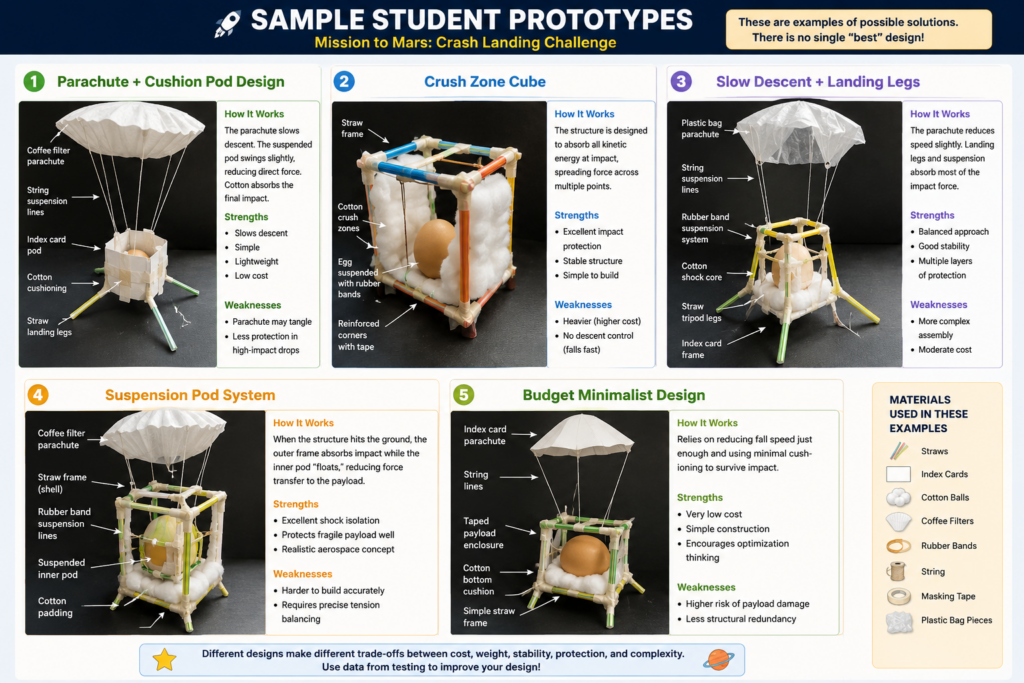
My Mission to Mars: Crash Landing Engineering Challenge asks students to design a lander that protects its payload while working within size and budget limits. It gives them a chance to experience how testing, trade-offs, and redesign shape a solution.
5. October Sky
Rocketry, curiosity, and learning from unsuccessful tests
October Sky follows a teenager whose interest in rockets leads him toward possibilities beyond the expectations surrounding him.
For science class, one useful connection is the relationship between testing and improvement.
We tell students that unsuccessful attempts are part of science and engineering. But when their own design falls apart, that can be hard to appreciate.
A story gives them some distance from that frustration and a chance to examine what makes an unsuccessful test useful.
Ask students: What information would you need from a failed launch to improve the next design?
Take it further: After an engineering challenge, have students submit a short redesign explanation. Ask them to identify the evidence that informed a change, rather than simply describing what they changed.
6. Hidden Figures
Space exploration, representation, and the people behind scientific achievements
Hidden Figures tells the story of Katherine Johnson, Dorothy Vaughan, and Mary Jackson and their work at NASA.
It offers an opportunity to look beyond mission names and launch dates to consider the people whose contributions made those achievements possible.
It also creates room to examine how access, recognition, and opportunity shape scientific work.
Because the film dramatizes historical events, students can practice distinguishing between a compelling scene and a historical account supported by sources.
Ask students: How does learning about the people behind an achievement change your understanding of it?
Take it further: Have students research a contributor to a scientific achievement. Their explanation should describe the person’s work, the evidence supporting their account, and any barriers that affected their opportunities.
7. The Martian
Survival in space and scientific problem-solving
An astronaut stranded on Mars has some immediate problems to solve.
Food. Water. Shelter. Energy. Communication.
The Martian offers connections across biology, Earth and space science, and engineering. It also gives students a reason to investigate whether a scientific idea holds up beyond the screen.
The goal doesn’t have to be catching every mistake. Students can examine what a scene helps them understand, what it simplifies, and what evidence would be needed to evaluate it.
Ask students: Which survival problem would you investigate first, and why?
Take it further: Give students one scientific claim from a selected scene. Have them classify it as supported, partly supported, or unsupported based on reliable sources, then explain their reasoning.
8. Dark Waters
Chemical pollution, public health, and accountability
Dark Waters centers on an investigation into chemical contamination and its effects on a community.
For environmental science teachers, it provides a starting point for exploring how environmental concerns are investigated and communicated.
This is one to preview especially carefully for mature content and fit. You may find it more useful for your own understanding of an issue or for planning a separate case study.
Ask students: What evidence would help you evaluate a claim that an environmental exposure is harming a community?
Take it further: Use an age-appropriate environmental case study. Have students sort information into three categories: what is known, what remains uncertain, and what additional evidence would help.
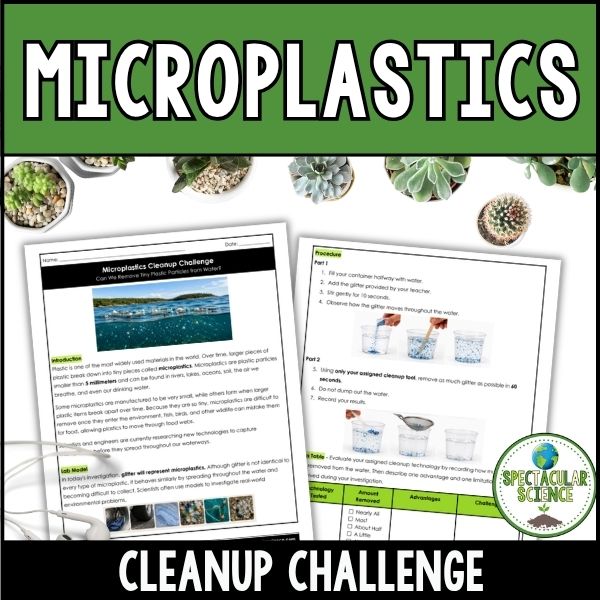
To extend the broader conversation about pollution and cleanup, my Microplastics Cleanup Challenge gives students a different contamination problem to investigate. They test cleanup methods and consider their limitations. Be explicit that microplastics and the chemicals discussed in the film are different pollutants with different treatment challenges.
9. Erin Brockovich
Water contamination and environmental justice
Erin Brockovich also examines water contamination and a community’s effort to seek accountability.
Its potential teaching connection is the relationship between environmental information and people’s everyday lives. Water quality affects families, neighborhoods, and the trust people place in institutions.
Like Dark Waters, this film requires careful previewing for mature content. A separate investigation using public water information may be a better classroom choice than showing the full film.
Ask students: How can residents evaluate conflicting information about their drinking water?
Take it further: Have students investigate where their community’s drinking water comes from, who manages it, and where residents can find water quality reports.
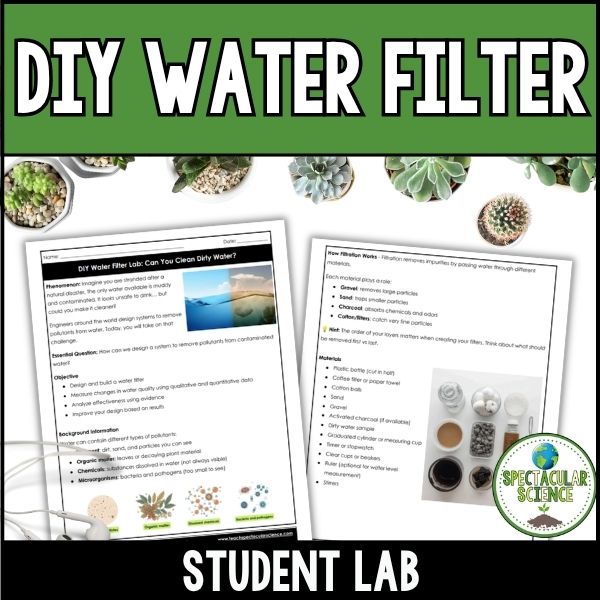
Then give them a water-treatment design problem with my DIY Water Filter Lab. Students build and test model filters, then consider what their results can and cannot tell them about water quality.
This is a useful place to reinforce that clearer water is not necessarily safe water. The model filters do not make water safe to drink or demonstrate removal of the specific contaminants discussed in the film.
10. Jurassic Park
Genetics, biotechnology, and scientific ethics
Jurassic Park offers a memorable entry point into the relationship between scientific possibility and responsibility.
It also creates an opportunity to separate fictional genetics from established science. Students can investigate a claim instead of accepting an explanation because a character delivers it confidently.
For classroom use, preview for frightening scenes and violence, and consider whether a selected excerpt would serve your lesson better.
Ask students: Before using a new scientific technology, what questions should people ask about its possible consequences?
Take it further: Have students investigate one scientific claim from the film. Then ask them to explain both its scientific limitations and an ethical question it raises.
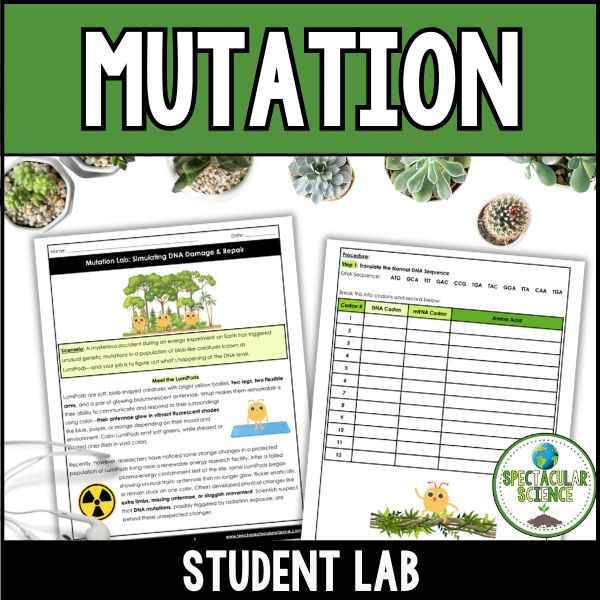
To bring the conversation back to a classroom genetics model, my LumiPods Mutation Lab connects changes in genetic information to protein function and traits. Students can compare the purpose of a simplified classroom model with the much bigger leaps made in a science fiction story.
How to Make Movie Day a Meaningful Science Lesson
You don’t need a question for every five minutes of screen time.
I’d rather give students a few questions worth thinking about and enough space to develop their answers.
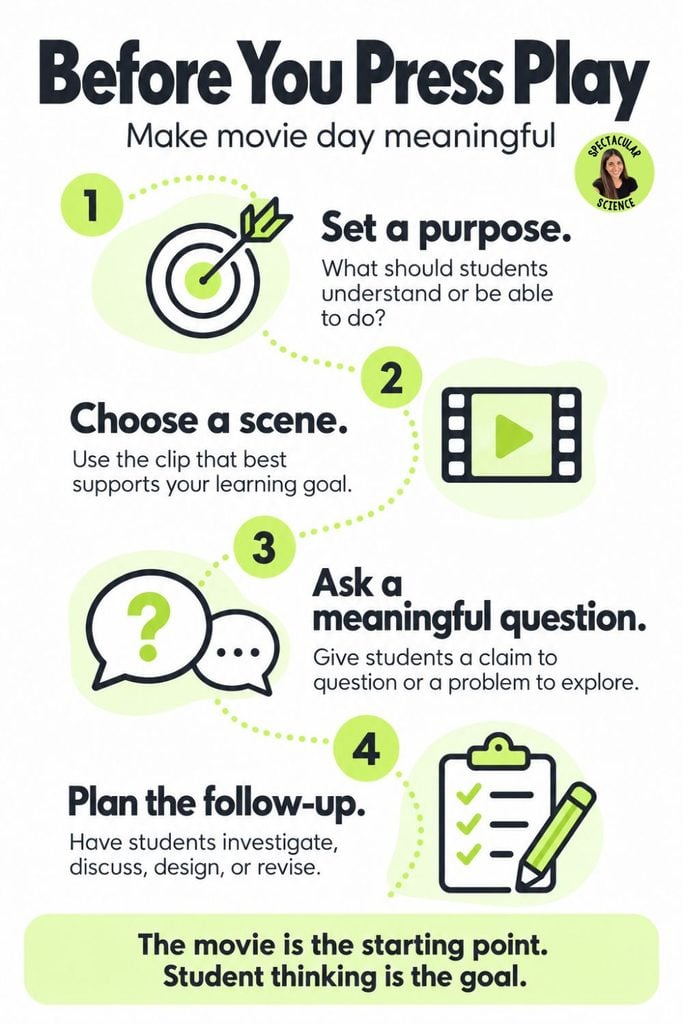
Start With a Purpose
Before selecting the movie, finish this sentence:
“After watching, students will be better able to…”
Evaluate a claim? Explain a trade-off? Identify engineering constraints? Question a simplified portrayal of science?
That goal helps you decide what to show and what students should do afterward.
Consider a Scene Instead of the Whole Movie
A short excerpt may provide everything your lesson needs.
It also leaves more time for students to investigate, discuss, design, or write. Choose the amount of viewing that serves the learning goal.
Give Students Something to Reconsider
Ask for an initial response before viewing, then return to it afterward.
For example: “What makes a business sustainable?” or “What information would you need before approving a new technology?”
Students can revise their answers using examples from the film and evidence from additional sources.
End With Evidence of Thinking
A follow-up task should reveal more than whether students paid attention.
They might:
- Evaluate a scientific claim using reliable sources
- Propose a solution and explain its trade-offs
- Revise a design based on evidence
- Compare a dramatized event with a historical account
- Explain what a movie leaves out or oversimplifies
The movie provides a shared starting point. The task gives students somewhere to go with it.
A Movie Can Be the Beginning of a Good Question
I kept returning to A Smile as Big as the Moon and The Lorax because I saw value in what they brought into my classroom.
One made room for conversations about space, empathy, and inclusion. The other gave us a way to explore sustainability through a story students could recognize and question.
A movie can make an unfamiliar issue feel worth investigating. It can give students a decision to challenge, a claim to check, or a problem they want to solve.
And that’s a pretty good reason to press play.
What movie has earned a place in your science classroom, and what do you do with it beyond watching?
RELATED POSTS:
- A Better Way to Teach Sustainability
- A Better Way to Teach Sustainability: Part II
- When Students Don’t Care About Science…How to Spark Engagement That Actually Works